Tuesday, April 27, 2010

DEFEND OUR PUBLIC SERVICES FIGHT THE CUTS

The JDA believes that Jersey’s public services are a vital bedrock in sustaining the local economy and the community both in good times and now, during the worst economic recession in living memory. They ensure essential investment in infrastructure and support for business, and can mitigate the worst social and economic consequences of the downturn. As public services come under increasing pressure to cut costs and jobs, we believe that the Treasury Miniter’s view that spending cuts are the only option needs to be robustly challenged. For Jersey to emerge successfully from the current recession in a strong position for the future, we need to strengthen and sustain our public services.
We believe that that before we can decide on any measures, the public and the States must be in a position to fully understand the first year (2%) cuts in the context of :

a) the full (10%) cuts to be applied over 3 years, and
b) the possible tax changes that that might mitigate the cuts

Deputy Southern has called for such an open debate. The Treasury minister has refused to take part.

Public sector workers know that 10% cuts cannot be forced through without major disruption to services to the vulnerable and large-scale redundancies. This in turn will make the recession worse and further delay any recovery.

The Council of Ministers of ministers appears to be hell-bent on cutting services. Those services that are not scrapped will be subject to outsourcing or outright privatisation. This will result in lower standards of delivery and reductions in terms and conditions for workers as it has in the UK and elsewhere.

The first cut has already taken place: the arbitrary, unilateral and perverse decision to impose a pay freeze, and thereby an effective cut in public sector pay, removing at a stroke some £7m from circulation in an already depressed economy.

The teachers may have led the way in opposing the reactionary and oppressive tactics of the ministers, but this is just the start of a long campaign. We call on all workers, private and public, to oppose these drastic cuts.

JERSEY NEEDS JOBS - NOT REDUNDANCIES

Thursday, April 22, 2010

March and Rally, April 24th

There will be a March and Rally in St Helier on 24th April 2010, led by Jersey's teachers, and supported by other public sector workers and their families, to protest at the abrogation of normal pay negotiation by the Council of Ministers and the States of Jersey Employment Board.

The March will begin at Howard Davis Park, gathering at 11am for a 12 noon start, and proceed to a Rally at The Opera House, with a possible secondary Rally in Parade Gardens, should the crowd exceed The Opera House's capacity.

Below is an abridged version of the final confirmation document from the organisers' legal advisors to the organisers and authorities, to clarify arrangements.

PLEASE GIVE THE MARCH YOUR SUPPORT, IF YOU ARE ABLE TO COME.

Stewards will be present at the entrances of Howard Davis Park to count the number of participants entering the park. Once the march starts, stewards will count the number of  participants  leaving the park

Announcements will be made in respect of the contingency plan in Howard Davis Park prior to the march starting. Participants are not to walk more than 4 persons abreast along the march route, particularly through the centre of town (Queen Street / King Street). Stewards will monitor this and direct people along the route as necessary. Announcements will also be made about safe dispersal from either the Opera House / Parade Gardens.

The march is to begin at approximately 12 noon. Local Radio Stations have been advised to warn road users and the public to stay clear of Howard Davis Park around this time.

Howard Davis Park MUST be vacated by 1.30pm at the latest.
The March

Honorary Police will be located along the march route closing roads / diverting traffic. An officer will be available to spearhead the march. …
Stewards will be located at key points along the march, directing participants to keep a smooth flow.  Stewards will be positioned at Snow Hill to carry out a further people count. Once approximately 650 people have passed, a steward will form a marker to alert the stewards at the junction of York Street / Seale street to direct any overflow toward Parade Gardens.

Stewards will be located along the march route with megaphones to direct participants and make sure there are no blockages, or disturbances. ...
Stewards will be at the spearhead of the march and at the rear of the march, and as discussed above, at key points along the march.

Contingency Plan

In the event of the contingency plan i.e. that more than approximately 650 participants are in attendance, provision is made to direct any overflow at the junction of York Street / Seale Street to Parade Gardens
Stewards / Legal Observers

The NASUWT / NUT are to provide approximately 20 stewards (hopefully more) comprising of locals and non-locals.

There will also be 4 legal advisors present from Viberts, with a contingency plan of more should there be larger numbers than expected.

A full briefing will be given to the stewards at 10am regarding health and safety, and the march route and contingency plan.

Vacating Opera House / Parade Gardens

Stewards and Honorary Police will be positioned at the Opera House / Parade Gardens to ensure a smooth dispersal of people and to ensure the public traffic and road users are not overly disrupted. Special provision will be made outside of The Opera House to ensure the participants / public are not forced onto the actual road. There will be a States Police attendance also.

Monday, April 19, 2010

When are you going to start working for us?

This was a genuine constituent's email! To which Shona replied in detail, worth quoting here for anyone else who has not noticed her four-and-a-half years of hard work.
Dear JDA

I am a resident of the Val Plaisant area an area which am informed has two JDA deputies. For a, and i use this term loosely, party, which is meant to represent its people i have yet to see any evidence. Im not talking about historic abuse of gst im talking about the everyday issues. For example the fact bins keep being removed, the fact you have to avoid dogs mess walking around the union rd val plaisant and st marks area. The fact that both the pavements and roads are in terrible condition the list goes on.

I am disgusted at the fact none of these long running issues have been resolved. I also believe that as elected members you should stop your Arthur Skargill impressions crawl out of the unions backside stop antagonising the senators who DO represent the people and put your parishoners first.

You attitudes would not be accepted anywhere else and as a voting tax payer i am bitterly dissapointed.

Thank you for your email. I have to firstly say that if a concerned resident does not contact one of us Deputies (there are 3), then how do we know that we should be acting on such problems - we simply can not spend our time walking around St Helier looking for dog poo on pavements and moving bins. So as you have now brought them to our attention, I would be happy to meet with you so you can show me.

Secondly, if you were to ask in your email what have we done or are doing in the District, then you would not have come to the conclusion and presumed that we do nothing.

Deputy Southern has brought more propositions and questions to the States than any other States Member in the last four years; he was Chair of the Economic Affairs Scrutiny Panel for 3 years in the first 3 years of government scrutiny, which produced more reviews each year than any other Panel. He is now on 5 different reviews. He is also on the Town Park Working Group, and successfully won a proposition to maintain the £10 million to work on and construct the Town Park - I am surprised that you think this means nothing to you as a resident near the proposed park site. Deputy Southern is also well known for his work with constituents and the high number that he manages to sort out.

Deputy de Sousa is on the Housing, Health and Social Security Scrutiny Panel and is also a member of 3 other sub-panels (Chairing a review into dental practise and cost). She also has the largest amount of constituent work of all the new States Members, and is on several Parish Committees, including the Battle of Flowers Committee, which she Chairs - she feels very strongly that this Jersey tradition should not cease - pretty impressive as a non-local and the only St Helier Deputy on the Committee.

As to me, well I invite you to spend a day with me so you can see how much I do. However, firstly I feel I have to brag a little to you: I am currently on the Economic Affairs Panel, and 2 other sub-panels. I have 33 live cases (most now in my district), which range from individual income support and incapacity benefit issues; to damp states housing and poor maintainance, inadequate housing and getting people moved, and poor insulation; and planning issues; child protection issues; fighting for people's housing qualis; anti-social behaviour; helping people with financial problems; parish utilities; maintenance of States sporting facilities. Since I have been in office, I have helped in my district people living in:

- Convent and caesarea courts- informing them of intentions of Housing's property plan.
- Convent and caesarea courts - a number of individuals
- Windsor road - provision of adequate bins
- Dorset street - a number of different individuals
- Oak tree gardens - provision of heating in houses
- Clos du Mon Sejour - got residents speed humps and helped them with issue with Bartletts potatoe packing factory
- Vauxhall Gardens - a number of individuals.
- Vauxhall Street - a number of indiduals.
- Hue Court - a number of individuals
- Val Plaisant - a number of individuals
- Springfield - a number of residents who live in and around the stadium
- Grands Vaux Estate - a number of residents
- Nicholson Close on Grands Vaux estate - the recent floods
- Victoria Road - a shop owner
- Journeaux Court - several residents
- Clearview Place - several residents insulation problems
- Clarendon Road - group of residents concerned at airtel mast
- Clarendon Road - a number of individuals
- Devonia Close (Devonshire Place - a number of individuals

and this is only what I can remember, and not to mention the people outside of my district. I have also brought propositions to the States: trying to get a direct public vote for the Chief Minister; exemptions on GST; ceasing the dual role of the Bailff; a vote of no confidence in a Bailiff (then Attorney General)who allowed a known paedophile to work as an honorary policeman and who subsequently, went on to abuse young women whilst in this role; GST exemptions; and tried to overturn the unnecessary pay-freeze on states workers, many of whom have had below inflation pay-rises for a number of years running up to the last pay-freeze without complaining.

Other tasks that I have not included that we undertake: attending all sorts of presentations; Parish Assemblies; preparation for States sittings; attendance on independant bodies and Parish bodies; and giving an ear to those who just want someone to talk to.

It is unwise to make presumptions when you know nothing about the subject you are complaining about!

As I said earlier, I would be quite happy to meet with you, to discuss and get the ball rolling on the issues you have raised. I am not free until about Thursday afternoon or Friday, as am in the States from tomorrow. Notwithstanding this, if you text me on: 07797 778561, I will answer it during lunch times.


Yours truly,


Deputy Shona Pitman

Sunday, April 18, 2010

TREVOR’S ORAL QUESTIONS FOR TUESDAY 20th APRIL 2010

“Funny how ‘investigative’ journalists and ‘political’ correspondents sometimes seem to be anything other than what most of us would see as remotely ‘investigative’ at all. Indeed, I was tempted to say the same with regard to being ‘political’.

But like so many members of the public who contact me from all over the island, becoming increasingly cynical, I too have to come to wonder that such apparently staggering diversions from what surely must be outlined in some professional’s job description is in fact all too ‘political’ in origin after all; perhaps entirely so.

Of course, another possibility that I suppose one has to consider is that such journalistic anomalies arise from nothing more than a spectacular shortage of good old ‘testicular fortitude’ faced with the dilemma of digging out and reporting something that might not sit at all well with many in positions of great power.

Whatever the reason next Tuesday could be very… interesting…”

Deputy Trevor Pitman


Oral Question to the Minister for Home Affairs ­


“Following analysis of the sworn affidavit of the suspended Chief Officer of the States of Jersey Police will the Minister advise the Assembly whether he has fully investigated every possible allegation of a conspiracy existing to remove the Chief Officer from office, further still, is the Minister wholly satisfied that no such conspiracy to remove the Chief Officer or to try to discredit him to justify his removal existed?"


Oral Question to the Minister for Economic Development 


“Having worked in support of residents at Albert Quay for over ten months, and residents having been promised that a solution was imminent before last Christmas, would the Minister advise the Assembly when he will finally be in a position to put an end to this anti-social behaviour by installing the agreed security barrier to control late night access to the areas directly under residents’ apartment balconies and bedrooms?”

Thursday, April 15, 2010

Speaking up for Public Services

Geoff Southern writes:-

A JEP editorial recently pointed to the irony of the States spending two days debating cycle helmets and only minutes on the so-called structural deficit of £64 m now facing us as “lacking a sense of proportion”. In the same edition of the paper the Business Editor, Peter Body, described our financial problems as needing, or about to get, “outright butchery”. As Jersey faces up to a public finance crisis of perhaps unprecedented proportions, public spending has become the key political battleground. Very little has been heard so far to counter the approach taken by the Treasury Minister which proposes deep cuts in public spending and thereby in public services. This paper seeks to open up the political and economic arguments that need to be debated at this time of economic turbulence, and to lay the grounds for rational decisions for solutions to the problems we face.

I start from the position, shared by many politicians and others, that Jersey’s public services are a vital bedrock in sustaining the local economy and the community both in good times and now, during what we are told is the worst economic recession in living memory. They ensure essential investment in infrastructure and support for business, and can mitigate the worst social and economic consequences of the downturn. But as public services come under increasing pressure to cut costs and jobs, I believe that the view that spending cuts are the only option needs to be robustly challenged. For Jersey to emerge successfully from the current recession in a strong position for the future, we need to strengthen and sustain our public services.

Cuts or Investment?

The recent Budget saw the welcome confirmation of Fiscal Stimulus spending amounting to some £44 m for 2009. Unfortunately only about a quarter of these funds have made it through the bureaucracy in 2009; the greater part of these funds have yet to be spent. We also saw the announcement of two major reviews over the coming months:
Comprehensive Spending Review (CSR)
Fiscal Strategy Review (FSR)

Underlying these major reviews however is a general principle held by the Treasury Minister that there should be, and will be, substantial cuts in public spending and services. This has seemingly taken place without a full discussion of the alternatives or the implications of cuts to public services.

The first cut has already taken place: the arbitrary, unilateral and perverse decision to impose a pay freeze, and thereby an effective cut in public sector pay, removing at a stroke some £7m from circulation in an already depressed economy. In both the short and long term this will come to be seen as a serious error. It will worsen recruitment and retention problems in essential sectors such as nursing and social work; it has further depressed employee morale and the trust in the ability of our ministers to protect hard pressed public sector employees; it will see the return of above inflation pay claims as the economy recovers.


Senator Ozouf boldly assumes that spending cuts are the answer. He is actively pursuing 10% reductions in public spending by 2013. This will entail “radical changes to service provision and some reduction in staffing levels”. What does this mean? The JEP business editor has tried to put this in real terms. It means massive job cuts in the public sector are likely. His pro-rata estimate of 600 jobs lost is close to my own estimate of 400. Examination of previous lay-offs at Jersey Post, JT and JNWW with the associated cost savings suggests that redundancies on this scale may come about.

Recovery delayed

The first thing to recognise is that, according to the Chief Minister’s own figures, this number of redundancies will immediately impose a further negative impact on States revenues of up to £14 million annually, in lost income tax and additional Income Support payments. One might add to this, redundancy payments of around £3 million and an unknown sum in indirect taxes, as spending is curtailed. Let us say a further £20 million added to the so-called structural deficit. The net effect of this sort of cut would inevitably be a worsening of the recession, perhaps producing a “double dip” as the recovery is further delayed. Unemployment has hit 1,300 including some 300 “actively seeking work” on Income Support. The bill for Income Support is already running at £76 million annually. Do we really want to further increase that with another 400 public sector workers thrown on the scrapheap? I believe it is the last thing we should do.

As the Minister so clearly puts it, there are only 2 options to address what he calls the structural deficit - either raising taxes or cutting public spending. He has set his face firmly against raising taxation on many occasions. By announcing his twin comprehensive reviews last year in the Budget debate, the Treasury Minister cleverly avoided any major debate on the correct way to deal with public spending and the recession. This has put off any real discussion until the Annual Business Plan (ABP) in September 2010. The quality of this debate is also likely to be less than adequate since whilst details of the 2011 CSR will be revealed in April and lodged in July for September debate of the Business Plan, the level of overall cuts stretching into 2013 will not be known. Neither will the results of the Financial Strategy Review be clearly known. States members will be asked to choose between spending cuts and taxes without seeing the full picture.
Impartial Review?

That the content of these reviews is in any way likely to be impartial, fair and comprehensive must also be questioned. Despite several assurances given to the States that the Fiscal Review Steering group would contain members who favoured progressive tax measures, the Minister has failed to keep his word. The ministers of Economic Development, Treasury and Social Security along with the Chief Minister and the two Assistant Treasury ministers cannot be said to represent a good cross-section of economic thinking even when joined by the Constable of St Peter. The review will undoubtedly follow the tired old low-tax, low-spend free market approach that has already let us down.

In a superficial exercise which has nothing to do with the economic realities but merely exposed States members’ political prejudices, members were recently asked to say what “balance” they would find acceptable to address the £50m deficit between cuts on the one hand and tax increases on the other. Unsurprisingly figures like 70/30 or 60/40 in favour of cuts predominated.

This article seeks to provide a different context, to question the urgency of calls to cut the public sector deficit, and to set out the case for the vital role played by the public sector during the current recession and beyond. Our premise is that sustaining public services is vital to economic recovery and the future prosperity of the island.

Recovery is the best way to tackle the public deficit in the long term, and that means planning for a budget deficit in the short term until the recovery is firmly under way. Cuts in public spending would only have an effect on future competitiveness and would impact on the most vulnerable and needy in society. As argued by David Blanchflower, respected economist and former member of the Bank of England's Monetary Policy Committee:

'Lesson one in a deep recession is you don't cut public spending until you are into the boom phase.'

We know from history that, without effective government intervention, the cost of recession is borne hardest by those who lose their jobs and by the vulnerable and poor that depend most on public services. We also know the big mistake made in the late 1980s and early 1990s was to give priority to macro-economic policy to fight inflation over employment and welfare policies. The words of David Blanchflower must be taken seriously. We must be sure that we are well into recovery before we make spending cuts. The proposal from PAC to make cuts earlier is even more dangerous and must be firmly rejected.

Jersey is a wealthy jurisdiction. Average pay is among the highest in the world, while marginal personal tax rates for the highest earners are low for a country with fully developed public services. We have been for many years, and still are, a low-tax, low-spend jurisdiction. The time has surely come to abandon the concept that we can continue to apply the same low-tax business model to the Jersey economy. Tax increases for the better off will not be popular but will be necessary and preferable to slashing those services on which the poorest and most vulnerable rely.
The time has surely come to start to address the gap between the rich and poor. The commitment to do so was reluctantly accepted by the Council of Ministers in amendments to the Strategic Plan. This must involve due consideration of truly progressive tax and social security policies as part of the Fiscal Strategy Review. However given the make up of the review panel a fair and honest assessment of progressive policies looks extremely unlikely.

How did we get here?

Frank Walker was often prone to repeat his adage “We are where we are” to preclude debate on how we got here. Today we are told that the recessionary position we find ourselves in is the result of hidden and uncontrollable market forces – almost a force of nature. We are the innocent victims of the world economy. This is not so. The worldwide recession has been caused by over-reliance on a single industry, banking, and the worst hit have been the most dependent, and with the lightest regulation. Does that fit Jersey? I believe it does. We are certainly way ahead of our competitors in terms of our dependance on financial services according to the Foot Review of British offshore financial centres.


So we are the most dependent of the offshore centres on the finance industry. We are a monoculture. Are we equally the innocent victims of market forces or have we contributed to the position we find ourselves in today?

Who is to blame?

No one would deny that we have a serious problem with the state of the island’s economy. The recession has resulted in a halt to the recent economic growth we have experienced and as a consequence, we are faced, according to the Treasury minister, with a large “structural deficit”. Discussed below is the extent to which we can describe the deficit as “structural” or “cyclical” and examine a number of decisions made by our government to determine to what extent our ministers have added to the problem of the deficit.

Zero/ten

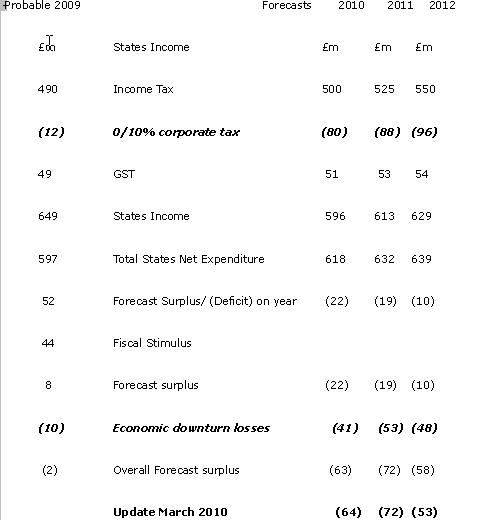
Examination of the 2010 Business Plan figures (June 2009) show the dominant influence of two negative elements:


Mistake 1 The single largest contibutor to the defecits we face is the decision to adopt the “zero/ten” company tax policy. This was a conscious decision taken by the current Chief Minister and supported by the current Treasury minister to give up £80 to £100 million tax revenue from companies. A 10% rate for non-finance companies effectively allows foreign companies to trade in Jersey for free. The 10% rate for finance companies reduced their contibution by half. The aim was to compete with the Isle of Man and satisfy the EU Directive on Business Taxation. The policy was a failure. We threw away £100m in tax revenue only for the EU to reject the scheme. We have to think again.

Mistake 2 The introduction of the regressive GST on all goods and services (including essentials) effectively transferred half the tax burden from companies to ordinary residents, especially the least well off. Further tax revenues (£10m) were to come from “20 means 20” on middle earners; £5m or so from IT IS and the remainder (£20m) was to be found from growth in the economy. The ministers gambled on the continuance of the rampant growth in finance sector GVA (up by 20% over the years 2005 to 2008) and in profits (up by a massive 35% in those years). This proved to be an expensive gamble; it has also failed. Negative growth is now predicted at -4% in 2009 and -2% in 2010 following the world banking crisis.

Mistake 3 At the end of 2008 the States exhausted itself in a long and bitter debate over the replacement of the EFW plant. I do not wish to revive the debate over the pros and cons of this decision here. However, the Treasury minister immediately brought a new proposal before the exhausted Assembly to pay for the EFW plant all in one go, in a single payment of £110m, instead of over a period of years. This had the effect of emptying the Consolidated Fund at a stroke. In addition to the £150 m we have in the Stabilisation Fund to contribute to assisting with the effects of the recession, how much better it would be to also have the £110 m to help cushion the blow.

The Treasury Minister repeatedly refers to the deficit as structural and not cyclical. A structural deficit is more serious and requires drastic action according to him. The fact is that the “structural” change to our economy and tax generation was the choice to adopt zero/ten. The blame for this lies entirely in the court of Senators Ozouf and Le Sueur. The economic downturn losses above are absolutely and clearly cyclical. They result from the “automatic stabilisers” of reduced tax revenues and increased expenditure on benefits during the recession. This situation will improve as the economy recovers. It should not be used as an excuse to launch massive ideologically driven cuts to the public sector.


The cyclical nature of the economy is clearly illustrated by Figure 1.3 above. The downturn in the economy over the years 2001 to 2004 showed similar reductions in GVA to those predicted for this recession. There was no panic then to slash the public sector workforce and thereby make the downturn worse. There should not be now.

How big is the problem? - 1


There is no doubt we are in a mess over the economy. The questions which need to be answered are how big is the mess and how do we set about clearing it up? Indeed first we have to ask which mess are we talking about? Well, there is the mess made by the recession and the mess we were already in (the £90 m revenue deficit caused by the mistaken move to zero/ten) that the recession has simply brought to the surface. The first thing to do in attempting to deal with the issues is put the situation in context. We remain a wealthy juristiction as shown here (Jersey Economic Trends, 2009).


Not only that, but we are undoubtedly a low-tax low-spend economy (T & R minister may 19th 2009).


Not only do we have a much lower spend overall than the OECD average , we have a lower “social” spend as well. I include Luxembourg in the comparison for those who wish to argue that our lower spend is a merely a product of our high GNI. If further proof were needed we need only consider the comparison made by Peter Body in Business Brief of March 2010, entitled “Who’s better off” summarised here:


The Business Editor of the JEP, an experienced observer of local economic issues describes the initiatives of the Treasury Minister and the PAC to slash 10% from public spending over 3 years or 2 years, respectively, in the following terms:
“Now they (PAC) propose immediate butchery in public services… Personally I believe it is simply crazy to expect a large complex organisation like the States to be dramatically restructured over three years let alone two. The obvious danger is that services the public have said they want and value will be damaged irreparably. Now we have PAC, panicking even more (than the Treasury minister) …. Certainly if you look at government spending elsewhere as a proportion of GDP, Jersey’s figure is very much lower than just about anywhere else.”

Public services are major employers and purchasers of goods and services. UK studies suggest that for every £1 spent on public services a further 64p is generated in the local economy. They create jobs, provide decent pay and pensions and set a benchmark in terms of equal opportunities. The imposition of a public sector pay freeze in 2009 may appear to be a popular short-term expedient, but it has fostered a deep resentment amongst public sector employees which will have long-term negative implications. The public sector pay target has been below inflation for the last three years. Further attacks on terms and conditions would not only reduce spending power in a key part of the economy, but also lead to recruitment and retention problems already evident in the nursing and social service sectors.

Siren calls for a deflationary package of public spending cuts in order to 'balance the books' are just ‘knee-jerk’ reaction and show no real understanding of the impact on front-line public services or indeed the potential to plunge the island into a 'double dip' recession. There is strong evidence, as Peter Body points out, that suggests the public is against such a strategy in any event. Senator Ozouf has set his mind firmly against any tax rises, and uses misleading figures to frighten the public into accepting massive cuts in public services which will harm the least well off and put recovery at risk.

The Treasury minister makes much play of the prospect of GST rates up to 12% by 2014, a figure produced by the CAG in response to a request from the Corporate Services scrutiny panel. This figure is however totally without any grounding in reality. It was produced on the two unlikely conditions that:
a)the States takes no steps to reduce increases in spending to below 6% annually, and
b)no other taxes are raised to meet potential deficits.
Such a scenario is completely unreal. Nonetheless Senator Ozouf is content to use this specious figure to bolster his one sided arguments for his failed Thatcherite policies.

He is equally unashamed by his repeated partial use of the facts and figures. For example he states accurately that States spending has risen by 30% over the past 5 years. He conveniently fails to put this apparently shocking fact in its proper perspective. He pointedly fails to mention the following significant changes in the economy over the same period:


Put into the context of an economy in growth mode with banking profits and overall GVA on the rise a growth in public spending is to be expected. As John Clennett (a previous Comptroller of Income Tax) stated in his recent contribution to the tax and spend debate: “States revenues and expenditure have been broadly in line and budgets have been balanced”. Interestingly the 21% growth in income tax revenues over the period 2003 – 2007 is made up of a 51% increase in personal tax and zero growth of company tax. In 2008, GST, most of which is paid by individuals,was added to further exacerbate this shift away from company tax on to the individual resident.

How Big is the problem? - 2

We have all been immersed in tales of total doom and gloom in the UK media regarding the size of projected deficits in the UK and elsewhere. These are given for selected economies below. Note that the UK leads the way with nearly 12% of GDP in 2010. Whilst Philip Ozouf concentrates on the misleading 30% increase in spending and the spectre of 12% GST, the reality is far different. Far from being 12% or even 6% in terms of GDP our deficit, taking the latest projection of £64 million and GNI around £4,000m, is running at 1.6% of GNI. This is hardly the stuff of catastrophe that others are undergoing, requiring massive reductions in the public sector. No wonder the treasury minister alternates between describing our position as “serious” and “fantastic”.


If we are in a “fantastic” position as the minister says, then why does he insist that draconian cuts to spending are the only way forward? He says to a sympathetic gathering of businessmen “I am not afraid to make bold moves to cut spending and keep Jersey working.” The problem is that his cuts may well stop the recovery and worsen the recession.

Borrowing unashamedly from David Blachflower, I have a question for Philip Ozouf, Terry Le Sueur and Alan Maclean. What plans do you have to get unemployment down any time soon? If you want to transform a recession into a depression, go ahead and cut public spending. I would advise against it and so, I believe, would John Maynard Keynes.
Voters want jobs.

Wednesday, April 14, 2010

GEOFF FOLLOWS UP ON MINIMUM WAGES

Further to the recent unsuccessful attempts by JDA Deputies to set a more reasonable rate for the minimum wage, Deputy Geoff Southern will bring this proposition to firm up the good intentions expressed by the Social Security Minister during the debate:-

The States are asked to decide whether they are of the opinion:
 
a).        that the minimum wage should be set at 45% of average earnings, to be achieved over a period of not less than 5 years and not greater than 15 years from April 2011 ; and
 
(b) to request the Employment Forum to have regard to this objective when making its recommendation on the level of the minimum wage to the Minister for Social Security.

Deputy G P Southern


REPORT

In summing up the debate of P212 / 2009 which followed extensive debate on P14 /2010, the Minister of Social Security had the following to say:

“.. it has been difficult for me to bring forward a recommendation… because it has been a slight step back from the percentage of the previous year, and I strongly believe that they (Employment Forum)should be bringing forward recommendations which increase the level towards the 45%”.


Minimum wage level - principles

The Employment Forum recommended in 2006 that the minimum wage for April 2008 should be set by reference to 40% of the overall average weekly earnings, as released in the June 2007 average earnings statistics. This was based on evidence that minimum wages in other jurisdictions are generally around 40% of the average wage of those jurisdictions.

In making its recommendation, the Forum had been influenced by the Economic Advisers advice regarding the States inflation policy and caution regarding the competitiveness of export driven industries. The Forum emphasized that if the States of Jersey wished to raise the bottom end of earnings, the minimum wage must equate to more than 40% of the average wage in future. Ideally, the Forum would aim to gradually increase the percentage of the average wage used in the formula towards 45% in the future. For example, 40.5% of the average wage would have given a minimum wage of £5.47 for April 2007. The Forum intends to take this into account in its 2007 internal review of the proposed uprating mechanism.

By 2008 the principle of raising the relative purchasing power of the minimum wage to over 40% of the average had been adopted.

“The Institute of Directors suggested that the minimum wage should be £6.08 per hour, based on a formula of 40.5% of the June 2008 average weekly earnings. Although a number of respondents said that the formula should not be increased beyond 40%, the Forum considers that this is based on an expectation that the 40% figure itself will be significantly above the average earnings figure.”


They concluded as follows –
“The Forum unanimously agreed to show a commitment to very gradually increasing the minimum wage above 40% of weekly average earnings (half a percent increase for 2009).
The Forum recommends a minimum wage of £6.08 to apply from 1st April 2009.”

Recent debate

On 25th March the States decided that it would not support either my proposition P14 / 2010 or Deputy Trevor Pitman’s amendment which maintained the 40.5% standard and raised the level to 41%, respectively. Given the impact of the recession, the Assembly decided instead chose to go along with the recommendation of the Forum.

The Social Security Minister, despite supporting the recommendation, appeared to lend his support to the principles outlined by the Forum above when he stated in his summing up on P212 / 2009:

“… I believe that there should be (a formula) and we should over time see it moving up”.

In the debate on this issue I pointed out that the level of the minimum wage, whilst clearly being an economic decision, was also one which was legitimately also a political one. In establishing a minimum wage the States have quite properly committed themselves to the protection of our lowest paid employees. I argued that this protection must be at least maintained and when possible raised along the lines suggested by the Forum. The Social Security Minister appeared to give support to this approach when he said:

“Sometimes this Assembly has not always felt itself able to make difficult decisions in times of good when we should have done … part of the role of government is to put pressure on business to do the right thing.”

As the minister made clear, politics (though not “politicking”) has a role to play in setting the minimum wage rate. He finally made his personal position on the minimum wage crystal clear, when he stated:

“I have made it clear to the Employment Forum that when we are out of recession, they should have the courage to come forward with increases because it is only right and proper that they do so.”

This proposition, I believe, allows the Assembly to put its weight behind the Minister’s obvious support for the principled approach adopted by the Forum, and sets the right political framework within which the Employment can feel supported in judging the pace at which the minimum wage rate can be improved.

There are no manpower or financial implications for the States in this proposition.

GEOFF CALLS FOR TIME TO THINK ABOUT POST OFFICE CARVE-UP

Deputy Geoff Southern will be challenging the potentially disastrous proposal to destroy the viability of our postal service in the name of free-market dogma, initially with this proposal to delay a decision until the consequences have been properly assessed.:-

The States are asked if they are of the opinion

To request the Minister for Economic Development to extend the period of consultation over the granting of postal licences to Citipost and HubEurope so that members may be fully informed of the consequences of such action by the JCRA

Report

On Wednesday 31st March 2010 the JCRA placed an advert in the JEP (see over) of its proposal to grant a Postal Operator’s licence to Citipost and HubEurope to convey large letters and packets, which includes CD and DVD fulfilment post. The closing date for comment is midnight 30th April 2010.

Jersey Post’s managing director has accused the JCRA of “failing in its duty to properly assess the impact on the traditional postal business.” Mr Carr stated that the decision to open the whole of the bulk business mailings market could result in substantial cuts to future services including a reduction of deliveries to every other day and the existing Post Office network being halved.

Despite being assessed in 2006 by the JCRA as an efficient operator, and recently agreeing a 4-year modernisation deal with the Communication Workers’ Union (CWU) which included the loss of 80 jobs, the Post Office see this as an “attack” on the only profitable part of the business leaving losses to be picked up by Jersey Post or the taxpayer.

The CWU agrees that the long-term viability of Jersey Post is seriously threatened by the introduction of competition to this market. They state that they “will not sit back and watch the decimation of this very valuable social service carved up and destroyed through the introduction of phoney competition designed for the benefit of a few at the expense of the many”. They are calling for urgent talks with all stakeholders including States members.

It is my opinion that such a radical move cannot just be allowed to proceed in such a timescale without full consideration by the Assembly of the potential impact on the infrastructure of the island.

There are no manpower and financial implications to this proposition.

PEOPLE, POLICY & PUBLIC CONCERNS – TREVOR’S WRITTEN QUESTIONS FOR THE STATES SITTING ON APRIL 20TH

[From the main JDA website; www,jdajersey.co.uk ]

Once again Trevor’s written questions for the forthcoming States sitting arise from a mixture of his St. Helier No. 1 District constituent work, further contact from individual islanders relating to on-going issues of wider public concern, and matters linked to established JDA policy commitments.

The recent JCRA proposals, not to mention the distinct lack of adequate political information, has left a lot of people from all political perspectives scratching their heads, Trevor told www.jdajersey.co.uk.

‘If we are serious about maintaining a proper daily delivery service for standard letters, keeping costs as low as is practical linked in with protecting jobs – not to forget the hugely important ‘social’ aspect of many older and/or disabled people actually having that contact with ‘the postie’ – then the competition for competition’s sake approach makes no sense at all. Hopefully,’ Trevor adds, ‘the States will see sense and agree to Deputy Southern’s proposition to ensure a far more in-depth analysis of all of this is implemented before any decisions are taken that could have disastrous long-term implications.’

Trevor tells us that his question relating to the unsafe ‘listed’ building in La Motte Street in St. Helier No. 1 District is also essentially about protecting jobs.

‘Letting people who have worked hard at developing their businesses suffer, due to an inadequate approach to ensuring ugly and obtrusive scaffolding such as this - deterring many shoppers, particularly visitors unfamiliar with the town – are erected and removed in the most rapid of timescales possible is simply not acceptable. The paving in the area has just been upgraded so this just makes a complete mockery of what we are trying to achieve at significant financial outlay.’

Ensuring adequate postal voting facilities are in place is a key aspect of all modern democracies committed to social inclusion, and with the commitments to building a more equal, fairer society featuring so strongly in the Strategic Plan it will be interesting to see if such statements really are little more than words. ‘Is it any wonder that so few turn out to vote in elections,’ Trevor observes, ‘when contrary to every modern democracy you look at Jersey has gone out of its way to make that as difficult as possible for many of those who already struggle to have their political voice heard.’

As to the questions to the Attorney General and the Minister for Home Affairs, Trevor feels these speak for themselves, being related to issues that understandably continue to strike a cord of intense interest with large numbers of the public.

Nevertheless, Trevor did tell us that with regard to the question to the Attorney General he had been contacted by a number of people from across the island expressing concern about material that has recently been made available via the internet and believing that there is a need for further answers to be provided publicly. To this regard Trevor also revealed that he had had a request within his original question for official confirmation that a death certificate had been made available to the Jersey authorities (in relation to developments in the case reported last year) turned down by the Bailiff on the grounds that this was not the responsibility of the Attorney General…

Here at www.jdajersey.co.uk we think the answers to all the questions below will make interesting reading. We will, of course, do our best to publish anything of particular interest in due course. For those readers wanting access to the answers to all written questions from States Members we would remind you that these are eventually available on the States own website.


WRITTEN QUESTION TO THE MINISTER FOR ECONOMIC DEVELOPMENT


“a) Given that Jersey Post has worked hard at improving efficiency, including the use of voluntary redundancy packages, and is only 4 months into a four-year plan, what action, if any, will the Minister be taking following the decision of the Jersey Competition Regulatory Authority (JCRA) to advise the public of its proposal to issue a Class 1 Postal Operator’s Licence to convey Large Letters and Packets to Citipost DSA Ltd and Hub Europe Ltd?

b) Would the Minister set out the impact that the grant of such licences will have for Jersey Post and confirm that the bulk mailing represents the core profit-making aspect of its operations? Would he further state whether the introduction of competition will lead to job losses and increased long-term costs for the public and would he state whether or not he supports the introduction of competition in this area?

c) Would the Minister state how both Jersey Post and competitors can survive and thrive financially in the years ahead within such a limited market where the comparatively unprofitable but socially essential daily mail delivery to domestic and business customers alike is intrinsically dependent on the more profitable side of the business?”


WRITTEN QUESTION TO H.M. ATTORNEY GENERAL


In view of the detailed States of Jersey Police ‘Sequence of Events: Macguire investigation’ timeline published on the internet recently together with the content of the Report by the Manager, Mental Health Services dated 23rd February 1999 and other material including the 26th July 1990 letter from the then Education Committee President, is the Attorney General satisfied that the decision of his predecessor (as summarised in e-mail correspondence from the now Deputy Bailiff copied to all States Members on 8th April 2010) not to pursue the case against Mr. and Mrs. Macguire was both wholly justifiable and correct and, if so, will he state why? Will the Attorney General also clarify whether the issue of Mr. Macguire’s stated terminal illness at the time was ever discussed in any shape or form as a potential justification/reason for not pursuing the case in the 1990’s?


WRITTEN QUESTION TO THE MINISTER FOR PLANNING AND ENVIRONMENT


Scaffolding surrounding a ‘listed’ but empty and unsafe business premises in La Motte Street is having a hugely damaging impact on retailers whose businesses are hidden from view from shoppers which is particularly damaging to potential business in relation from visitors to the island who will not know the hidden shops are there; what measures is the Minister taking to ensure that this eyesore is rectified and what assurances, if any, in terms of timescales can he give the proprietors of the retailers being negatively impacted upon as to when this scaffolding will be removed?
WRITTEN QUESTION TO THE CHAIRMAN OF PRIVILEGES AND PROCEDURES COMMITTEE

As access to a postal voting mechanism is a fundamental part of all modern, fully functioning, inclusive democracies, will the Chairman inform members what consideration, if any, her Committee has given to ensuring that those who wish to do so, especially the elderly and those with mobility problems or other disabilities, can easily vote by post in the coming elections in line with priorities 6, 8 and 15 of the Strategic Plan 2009 – 14?


WRITTEN QUESTION TO THE MINISTER FOR HOME AFFAIRS


"Further to the written and oral answer given on 9th March 2010 relating to the suspension of 2 officers from the States of Jersey Police for just less than 18 months would the Minister advise -

a) which person within the States of Jersey Police was responsible for taking the decision that resulted in the suspension of two police officers and whether the individual responsible for the original decision to suspend them was the same person who made the decision to re-instate them without charge? If so, does the Minister believe that this shows sound judgement?

b) that the costs listed in the answers of 23rd March 2010 showed the total cost to the States of Jersey Police of these suspensions and included all ancillary matters such as staff costs and overtime to cover the suspended officers?"

Saturday, March 27, 2010

FACT: WHETHER A PROPOSITION SUCCEEDS OR FAILS...

FACT: WHETHER A PROPOSITION SUCCEEDS OR FAILS REGULARLY HAS VERY LITTLE TO DO WITH THE QUALITY OR RIGHTNESS OF THE ARGUMENT BEING MADE...
 
Below you will find an internal  e-mail that was sent to all States Members from Senator Alan Breckon, who was Chairman of the Scrutiny sub-panel further made up of myself and Deputies Geoff Southern and Roy Le Herissier. As some readers might recollect the four of us, along with our excellent Scrutiny officer, Sam Le Quesne, worked flat out right through last summer - a period of some 18 + weeks overall as I recall - producing a review that concluded quite unequivocally that a fully independent Committee of Inquiry into the Management of the Health & Social Services Department was urgently needed. It was, of course, rejected by most of the usual crew as the attached States vote demonstrates.
 
The content of Senator Breckon's email was written in the aftermath of the final report revelations at yesterday's press conference. A press conference and later statement from the Minister where we hear yet again that regardless of the horrific findings in this particular case no-one will be held accountable. Once again it is apparently all about 'learning lessons for the future'. according to the Minister  Incredible but true. Still, having been a member of the Scrutiny sub-panel that put so much work into the review that had concluded an independent Committee of Inquiry was essential I did initially feel that I should make some observations on this issue. But reading Alan's e-mail last night I came to the opinion that actually, by and large, he had said just about everything of importance that needed to be said. Thus, rather than simply risk repeating his words I obtained Alan's permission to make his thoughts publicly available on the JDA's website.
 
I believe the content of the e-mail speaks for itself; as does the original proposition and States Assembly vote attached. I will leave readers to make up their own mind and ask the questions that result. Comments on the website are welcome as always. Equally, maybe these questions should be directed to the 30 States Members who chose not to support the proposition that Alan, Geoff, Roy and myself worked so very hard on in coming to our conclusions.
 
All I would add personally is the following. Until propositions - ALL propositions - are debated and voted upon according to their need and merit, rather than which States Members are behind them, or what damage to the image of Corporate Brand Jersey might occur if they were supported and passed government will never do the job that it should within a so-called democracy. Senior civil servants and employees who get things wrong, fail or simply do not do their jobs will never be made accountable as they should be. More serious than either of these two points, of course, in instances of this nature some of the most vulnerable within our society will never have the protection and security that should be theirs by right.
 
As for the Chapman Report...maybe we should be asking for a refund.
 
Deputy Trevor Pitman


From: Alan Breckon
Sent: 26 March 2010 17:35
To: All States Members (including ex officio members)
Subject:
Dear Colleague FYI I have attached the Proposition & Vote on whether to hold a Committee of Inquiry Into the Management of the Health & Social Services Department this is self explanatory.
 
All the existing Ministers + two former Health Ministers voted against!
 
However I wish Members to be mindful of the following;
on one hand I was accused of being mates with Civil Servants and therefore willing to move on without proper attention to detail where faults may have been found;
on the other hand I was accused of making mischief and not having any evidence of any malpractice;
if you re-read the short Report attached you will see that neither of the above is true;
I did not have another agenda, however I knew there were issues that went beyond the scope of the Panel's ability to investigate fully - hence the Committee of Inquiry;
In the Chapman Report Into Health & Safety issues on bullying, harassment, blogs etc he says this at para 10.19
"As it was put to me on more than one occasion: "people are keeping their heads down." To an outsider that is a critical concern as if action is not taken to address the problem it will firstly lead to inertia in the decision making process and ultimately a potential breakdown in normal day to day government. For example I understand that the States will in due course be required to decide whether to set up a Committee of Inquiry to investigate allegations of misconduct and incompetence within the management of Health & Social Services. I am aware from my own research for the purposes of this investigation that there have already been seven independent investigations and reviews covering much of the same ground. In the course of my research I read four of those documents either in whole or in part. It was quite clear that no evidence had been found in any of those reviews to justify any of the allegations made and the call for a further Inquiry appeared to me as an external observer to indicate an inability to move on and manage the present." (my emphasis)
 
so this Chapman bloke was telling us to "move on manage the present" - wonder who told him that? (the extract is attached below) How much was he paid for these little gems of wisdom? "wool" & "eyes" are words that spring to mind! 
the Scrutiny Panel became aware, through family situations with the Court that children had been returned to abusive situations over long periods of time.
this is proven by PUBLISHED case judgements and prosecutions - one for rape of a child
the Jersey Child Protection Committee (until most recently) had never held one Serious Case Review - we wondered how this could be? - we got 10 years of their minutes?
 
I hope this clarifies the situation for those 30 of you who voted against a Committee of Inquiry - this was not a point scoring exercise it came from an uneasy feeling that the Sub Panel of Roy, Geoff, Trevor and myself had for the situation we found.
 
So while the recent Report on the JCPC may be uncomfortable for some it was where sadly the Sub Panel knew somebody had to go - so well done to the JCPC.
 
Finally The Sub Panel & Officers worked very hard over about a 20 week period to produce a significant Report in a very sensitive area with lots to commend it - the cost - although I do not have figures to hand was about £15,000 and we did get some outside advice, however the Report was our own - the only lesson is that we all must learn is to open our minds to some of this stuff and NOT adopt the opposition stance or personalise issues - its too important for that!
 
Regards
Alan

View Vote P145/2009/(re-issue) 

Committee of Inquiry into the management of the Health and Social Services Department.   05 November 2009


POUR: 20    CONTRE: 30    ABSTAINED: 1   ILL: 1    EN DEFAUT: 1


Senator Alan Breckon
POUR

Senator Sarah Craig Ferguson
POUR

Connétable Alan Simon Crowcroft
POUR

Connétable Silvanus Arthur Yates
POUR

Deputy Frederick John Hill, B.E.M.
POUR

Deputy Roy George Le Hérissier
POUR

Deputy Geoffrey Peter Southern
POUR

Deputy Carolyn Fiona Labey
POUR

Deputy Collin Hedley Egré
POUR

Deputy Jacqueline Ann Hilton
POUR

Deputy Paul Vincent Francis Le Claire
POUR

Deputy Shona Pitman
POUR

Deputy Montfort Tadier
POUR

Deputy Angela Elizabeth Jeune
POUR

Deputy Trevor Mark Pitman
POUR

Deputy Tracey Anne Vallois
POUR

Deputy Michael Roderick Higgins
POUR

Deputy Andrew Kenneth Francis Green M.B.E.
POUR

Deputy Deborah Jane De Sousa
POUR

Deputy Jeremy Martin Maçon
POUR


Senator Terence Augustine Le Sueur
CONTRE


Senator Paul Francis Routier
CONTRE


Senator Philip Francis Cyril Ozouf
CONTRE


Senator Terence John Le Main
CONTRE


Senator Ben Edward Shenton
CONTRE


Senator Frederick Ellyer Cohen
CONTRE


Senator James Leslie Perchard
CONTRE


Senator Alan John Henry Maclean
CONTRE


Senator Bryan Ian Le Marquand
CONTRE


Connétable Kenneth Priaulx Vibert
CONTRE


Connétable John Le Sueur Gallichan
CONTRE


Connétable Daniel Joseph Murphy
CONTRE


Connétable Michael Keith Jackson
CONTRE


Connétable Graeme Frank Butcher
CONTRE


Connétable Peter Frederick Maurice Hanning
CONTRE


Connétable Leonard Norman
CONTRE


Connétable John Martin Refault
CONTRE


Connétable Juliette Gallichan
CONTRE


Deputy Robert Charles Duhamel
CONTRE


Deputy John Benjamin Fox
CONTRE


Deputy Judith Ann Martin
CONTRE


Deputy James Gordon Reed
CONTRE


Deputy John Alexander Nicholas Le Fondré
CONTRE


Deputy Anne Enid Pryke
CONTRE


Deputy Sean Power
CONTRE


Deputy Kevin Charles Lewis
CONTRE


Deputy Ian Joseph Gorst
CONTRE


Deputy Philip John Rondel
CONTRE


Deputy Daniel John Arabin Wimberley
CONTRE


Deputy Edward James Noel
CONTRE


Connétable Deidre Wendy Mezbourian
ABSTAINED


Deputy Anne Teresa Dupre
ILL


Senator Stuart Syvret
EN DEFAUT


Sunday, March 21, 2010

SHONA'S ORAL QUESTIONS FOR MARCH 23rd 2010.

Question One: to The Chief Minister

"Following on from the rejection of P9/2010 on 23rd of February 2010, when he stated that he would be appointing an independent expert in the shortest possible timeframe to undertake a review as to whether procedures with the suspension of the Chief (Police) Officer were correctly followed, will the Chief Minister inform Members whether the expert has been appointed and when the findings will be published?"


Question Two: To the Minister for Social Security

"Would the Minister inform Members, since the implementation of Income Support, how many recipients under 25 have applied for the Housing Component and how many have been refused?"

Thursday, March 18, 2010

TREVOR’S ORAL QUESTIONS FOR TUESDAY 23rd MARCH 2010

Always at the forefront of endeavouring to ensure the losses of ordinary workers’ jobs – public sector or private - really are the last resort after all other possibilities have been explored, Trevor’s oral question to the Minister for Economic Development raises this issue once again. Readers of the website will have their own views, of course, but as the JDA ask here, laudable though it is, viewed within the present economic climate is the maintenance of the ‘top 500 banks only’ mantra really more important than protecting 30 finance jobs that could have been saved?

Trevor’s oral question to the Home Affairs Minister, reference the spectacularly invisible Metropolitan Police ‘Interim Report’ raise issues that anyone remotely committed to ensuring transparency and natural justice surely agree must be answered – and without further delay.

Just who did produce it? What is really in it? Who has actually seen it – and more to the point who can verify this? Not surprisingly, given what with the best will in the world can only be described as the truly shambolic, strung-out process by which the island’s Chief Police Officer has found himself suspended (for what is now rapidly approaching 18 months), the question really can even understandably be asked: does the Metropolitan Police ‘Interim Report’ actually exist as a physical, written document at all?

Hopefully come next Tuesday we might actually begin to get some answers. If not then suspicions that all really isn’t as it should be can only be given more credence.


Deputy T.M. Pitman of St. Helier will ask the following question of the Minister for Economic Development ­

“With 30 jobs being lost at Kleinwort Benson due to the Regulator's refusal to grant a licence to a non-top 500 bank, will the Minister advise what support, if any, is being offered by his Department to the staff affected to try and help them find other employment in the sector; further still, does the Minister concede that the Regulator’s decision may actually be counter-productive?”


Deputy T.M. Pitman of St. Helier will ask the following question of the Minister for Home Affairs ­


“Will the Minister inform Members on what date in 2008 the Metropolitan Police were requested to forward an Interim Report, who requested it, whether it was used in connection with the suspension of the Chief Officer of the States of Jersey Police and whether the Minister will make the report available to States Members?”

Wednesday, March 17, 2010

Cuts must be Surgery, not Butchery.

The JDA have always taken the position that there is more that could be done to fill the looming “black hole” in Jersey's public finances by a range of fairly gentle alternative taxes, each raising a few million towards the necessary total. However, alternative taxation may no longer be enough, and it is time to look at expenditure, as well as revenue. The ordinary Jersey people we formed to represent are becoming increasingly concerned by the conspicuous bloat and the rising tax bills to pay for it, and, if we are to stay in touch and relevant as a party, we need to be turning our thinking to the subject. Most of the current JDA Council have worked in the public sector for at least part of our working lives, and should know the score. Speaking for myself, I would like to add my general agreement to the various calls for some trimming of public sector spending, to suit the harsh reality that we are both locally and globally entering the backstroke of the boom-bust cycle.

I also share the suspicion with others, that there is more dispensable surplus to be found at the shoulders of the States organisation than at the base. Thus, I would not endorse crude, untargetted pro-rata cuts across the board, but I would like to see our elected representatives defending the effective provision of public services, facilities and benefits, and letting go of otiose fripperies and side-tracks. Therefore, I would point out something that seems to have been overlooked, so far.

There is a balance to be struck in the administrative burden on front-line staff. It is plainly unacceptable for the operational workers of all types to be left to carry on without any supervision of how they work, nor accounting for what they have worked on. However, the insidious big inefficiencies are to introduce excessive supervision that makes no useful contribution to the task, and to collect unnecessary information on the off-chance that someone wants to know. (The latter is a personal bugbear of mine, as I used to be a UK Civil Servant spending around 45% of my time compiling statistics about our actual work, just in case some MP ever asked a question.) Before middle-management can be reduced, there must be a radical culture change in the public sector. If we are not to have unproductive support clerks churning out sheaves of never-to-be-read paperwork, then the front-line staff have to do it themselves. And if the front-line staff are taking time out of their real work to do their own admin, then that admin needs to be reduced to the bare minimum. Both private business and public service alike use “Due Diligence” as an excuse to waste time and money on unthinkingly gathering all sorts of useless data, these days. If shareholders of private businesses are content to let their management do this, that is their privilege. We are all shareholders of the state, though, and we should be demanding that judgement be applied with diligence, not just filing.

So, we need to develop a general policy of evaluating all procedures and structures by the question “Does this help or hinder getting the job done?”. The obvious targets are Assistant Directors and Managers. In some cases, I would expect that they actually do assist with an otherwise impossible workload. But, it can so easily happen that supervisors nearer the front line report in detail to them, for the Assistant to report in summary to the Chief Director or Manager, when the supervisors could have spent less time reporting in summary directly to the Chief, freeing 100% of the Assistant Manager's time for a more productive alternative position. Then there are forms with ill-considered boxes, that time must be spent completing and processing, to supply irrelevant information. If it is not something that needs to be known to manage effectively, it is not worth the bother.

There is a part for opposition politicians in this, too. When asking ministers to admit embarrassing statistics, they should give a thought to how much Civil Service time is going to be absorbed in compiling those figures, and how much more is going to be absorbed in future as the civil servants prepare for the chance of being asked again next year. Is it always worth £100 of clerical time to score a little point, that doesn't make the news anyway, at Question Time.

To sum up, we can fairly painlessly trim a lot of waste through a case-by-case examination of which management posts are effectively side-tracks, and an end to amassing statistics from habit instead of to a purpose. Only then, if still necessary, should we be scaling back the services and facilities that it is government's purpose to provide, and that in a prioritised way, not slashing by numbers.

David Rotherham

Monday, March 15, 2010

TREVOR’S WRITTEN QUESTIONS FOR 23RD MARCH 2010

Trevor’s written questions for next week’s States sitting take in three different ministries – Treasury & Resources, Home Affairs and Social Security. The first question to Home Affairs Minister, Senator Ian Le Marquand relates to the timescale for setting up an Independent Jersey Police Authority. The second relates to a proposition Trevor lodged late last year regarding the need to formulise an all-encompassing strategy to finally tackle youth offending.

Having agreed to put this on hold until 20th April to allow time for the unfolding of work being undertaken by Professor Andrew Williamson, Trevor tells us that with just a month to go he hopes the answer will give an adequate ‘progress report’ which will indicate whether to proceed with the debate or delay a little longer.

Trevor says that his questions to the Ministers for both Social Security and Treasury & Resources have their root in the need to identify any individuals ‘playing the system, whether this be at the top or bottom of the economic ladder’.

The question to the Minister for Social Security follows on from Deputy Gorst’s statement, quoted in the media last week, about benefit fraud. Given the department’s spend of £93.8 million, specifically it seeks clarification of the total amount of monies involved with the nine cases prosecuted by the department in 2009.

Finally, Trevor states that his questions to the Treasury & Resources Minister will provide further detailed background information in support of on-going discussions on taxation between the JDA and a number of other progressive politicians. He added:

‘Like the question to Social Services, the question put to T& R about the very lowest levels of tax payment amongst 1.1.K residents will help build up the true overall picture in order to achieve a full and fair perspective. With provision of both sets of figures it will enable us to move away from spin and hearsay in two, highly emotive areas of politics to examine cold, hard fact.’


WRITTEN QUESTION TO THE MINISTER FOR HOME AFFAIRS
BY DEPUTY T.M. PITMAN OF ST. HELIER
ANSWER TO BE TABLED ON TUESDAY 23rd MARCH 2010

Question

“Having agreed to defer my proposition P.201/2009 ('Strategy for dealing with young offenders: establishment of a working group') to await any developments arising from related work being undertaken under Mr. Andrew Williamson relating to the creation of a ‘Children’s Plan for Jersey’, will the Minister advise as to what stage this work has now reached and when he expects it to be concluded?”


WRITTEN QUESTION TO THE MINISTER FOR TREASURY AND RESOURCES
BY DEPUTY T.M. PITMAN OF ST. HELIER
ANSWER TO BE TABLED ON TUESDAY 23rd MARCH 2010

Question

“Given that with 123 such residents there is no possibility whatsoever of any individual being able to be identified will the Minister clarify the number of 1(1)(k) residents, if any, by year for the period 2005 to 2008 inclusive, who paid tax within the following brackets:

(a) less than £5,000

(b) between £5,000 and £10,000”


WRITTEN QUESTION TO THE MINISTER FOR SOCIAL SECURITY
BY DEPUTY T.M. PITMAN OF ST. HELIER
ANSWER TO BE TABLED ON TUESDAY 23rd MARCH 2010

Question

“Given that Social Security recently highlighted the fact that there had been just nine prosecutions for benefit fraud in 2009 would the Minister clarify the collective total amount of the de-frauded monies involved?”


WRITTEN QUESTION TO THE MINISTER FOR HOME AFFAIRS
BY DEPUTY T.M. PITMAN OF ST. HELIER
ANSWER TO BE TABLED ON TUESDAY 23rd MARCH 2010

Question

“Will the Minister advise what progress has been made regarding plans for the creation of an Independent Jersey Police Authority and further still, at what date does he believe the necessary preparation work will be completed and the Authority launched?”


WRITTEN QUESTION TO THE MINISTER FOR TREASURY AND RESOURCES
BY DEPUTY T.M. PITMAN OF ST. HELIER
ANSWER TO BE TABLED ON TUESDAY 23rd MARCH 2010

Question

“At present those 1(1)(k) residents granted such status after 1st January 2005 are taxed at the following rates:

The first £1m of foreign income at 20%
The next £500,000 of foreign income at 10%
The balance of foreign income at 1%
All Jersey source income at 20%

The Minister has further advised the Assembly recently that the taxation percentage of all 1(1)(k) residents can be legally increased/enhanced. This being accepted, will the Minister advise what increase in tax revenues could be expected if all 1(1)(k) residents were to be taxed instead at:

the increased rates of 25%, 12.5%, 2% and 25% respectively; or (b) alternatively by a straight-forward 1% increase in all four categories?”

Geoff's Written Questions for 23rd March 2010

1.to Treasury and Resources Minister

When the minister points out that public spending has risen by 30% over the past 5 years as evidence for the need to make drastic cuts in public services will he confirm that during this period:

a)half of that increase has come in the last 2 years, under his stewardship of the public purse;
b)when the control of inflation was his, and his predecessor’s, number 1 target, RPI(X) a measure of non-staff inflation totalled 17.7%;
c)wage increases, according to the AEI, totalled 22%, and
d)these figures do not include the decision to spend £103m on the EFW plant in 2008

Will the minister also give members details of the additional 190 public sector posts employed during this period, so that members can assess how many were front-line employees directly concerned with service delivery?

Will the minister also give members details of the 10 positions, along with the salaries, that he wishes to create to better monitor spending in his department?

2.to Treasury and Resources Minister

Will the minister condemn the approach taken by the Corporate Services Scrutiny Panel in requesting the CAG to produce figures for prospective GST rates required to eliminate budget deficits on the unlikely assumptions that:

a)no action was to be taken to curb public spending to below 6% annual increases, and
b)no attempt was to be made to raise further income from other taxes?

Does the minister accept that to project a 12% GST rate by 2014 is unnecessary scaremongering, and will he confirm that he has no intention of following any such misguided strategy.

Will he further confirm that he has no intention of raising the GST rate in the short term?

3.to Social Security Minister

Does the minister accept that the 3 levels of impairment component in Income Support are there to compensate those with an illness or disability for the increased costs of their condition and that successful applicants for these components should not have their benefits reduced through consequent reductions in other components?
What actions, if any, and in what timescale, will he take to correct this anomaly in the system which does not act in the best interests of those with a disability and, if none, why not ?


4. to Social Security Minister
In response to question 5133 about the Education Allowance (approximately around £30 per week available to less well off families of 16-19 year olds to encourage them to stay in education) the ESC minister had the following to say:

“It is my understanding that the form and extent of support available is unchanged, despite the fact that it is now available via Social Security rather than Education.”

Will the Minister inform members whether this allowance is still directed to 16-19 year olds in education and, if not, how and to whom is it now directed?

What structural differences currently exist in IS for 16-19 year olds in work and in education?

What action, if any, and in what timescale, will the minister take to create incentives to 16-19 year olds to stay in education, and if none, why not?

5. To Health and Social Services Minister

Will the minister inform members what budget provision, if any, she has made, or has under consideration, to fund payments for unpaid overtime or other additional hours to cover for understaffed services for:

4.nurses, and
5.other medical staff?

Will she further inform members of the extent to which any such payments are required for each of these groups by giving:

6.the number of staff affected
7.the total of additional days (or shifts) worked
the total sums required?

Friday, March 5, 2010

SHONA'S ORAL QUESTIONS FOR TUESDAY 9th MARCH 2010

Deputy Shona Pitman will ask the following question of the Minister for Housing ­

“In view of the heavy rainfall during the last weekend of February, would the Minister inform Members what action, if any, his Department have taken to prevent the regular flooding of houses at Nicholson Close?”

And she will ask the following question of the Minister for Economic Development ­

“Would the Minister inform Members whether any funding has been allocated to the tourism industry as part of the Economic Stimulus Package and, if so, how much and to what specific projects?”

Thursday, March 4, 2010

DEBBIE'S ORAL QUESTION FOR TUESDAY 9th MARCH 2010

Deputy D. de Sousa of St. Helier will ask the following question of the Minister for Economic Development ­

“Can the Minister inform members what steps, if any, the Economic Development Department is taking to address the buy-out of Kleinwort Benson, in view of the fact that Jersey prides itself on only allowing the top 500 banks on the Island?”

TREVOR’S ORAL QUESTIONS FOR MARCH 9TH 2010

The first of Trevor’s two oral questions for next week’s States sitting has been necessary due to “the not unexpected” move by the Chief Minister, Senator Terry Le Sueur to keep details of any additional payments outside of contractual entitlements relating to the recently resigned Chief Officer of Health & Social Services out of the public domain.

Trevor says that whilst the obvious response for the Chief Minister should have been to simply either confirm or deny that any such payments had been included, Senator Le Sueur had instead attempted to hide behind claimed ‘confidentiality’ and effectively refused to answer.

‘Any additional payments of taxpayers’ money outside of contractual agreements – agreements that all States employees must have under law – are not covered under blanket confidentiality’ says Trevor. ‘The response last month was, as I say, not unexpected, but it does once again show complete contempt for both transparency and the general public who are fully entitled to know what went on here.’

As a consequence Trevor says he decided to take advice from the Data Protection office before attempting to lodge a re-worded oral version of the question in order that he didn’t fall foul of getting it knocked back by the Bailiff due to any ‘loopholes’ as he says has happened before.

‘I’m pleased to say that Data Protection confirmed that in their view the entitlement in the ‘public interest’ that details of any possible payments outside of contractual ones should be made available was very strong. As was said, this was a top civil servant and any monies would come directly from the public purse. If politicians are not to be able to get answers on such fundamental issues then we really should drop any pretence to claiming that we are a democracy, let alone a government that is accountable to its people. It really is that black and white.’


Question One - Deputy T.M. Pitman of St. Helier will ask the following question of the Chief Minister –

“Given that any additional monies/severance payments outside of the contractual entitlement paid to the former Chief Officer of Health and Social Services would have been made from public funds, what justification can the Chief Minister give for not divulging the contents of the agreement to the Assembly in his written response on 23rd February, particularly in the interests of accountability and transparency (as outlined in the Ministerial Code of Conduct)?


Question Two of Trevor’s follows on from his written question on the 23rd of February that revealed the remarkable and eye-opening figures relating to the real amounts of tax actually paid by some of the island’s 1.1.(K) residents (details of which can be viewed on this site in an article below).

Given that Assistant Minister for Treasury & Resources, Deputy Eddie Noel had previously told the States that he was of the opinion that 1.1.(K) residents could not have their tax rates re-evaluated, and possibly increased like the general public, Trevor says it is absolutely essential that this be clarified.

‘With the much-trumpeted review of taxation being promised by the Treasury & Resources Minister this issue cannot simply be left to later be used as an excuse to actually do nothing at all in this area,’ Trevor told us; ‘worse, to actually use this as an excuse to instead increase taxation levels on ordinary working people. Not just so-called ‘middle Jersey’ residents, but those who can afford any increase, whether this be via increased GST or anything else, the least. Hence my question as to the legal standing of agreements made; particularly those dating back to before the current regulations from 2005.

Question Two - Deputy T. Pitman of St. Helier will ask the following question of the Minister for Treasury and Resources ­

“Would the Minister clarify under which aspect of Jersey’s tax legislation individuals were deemed able to be legally granted 1(1)(k) status and thus negotiate their own tax contributions with the Comptroller of Income Tax prior to 2005; and advise whether 1(1)(k) status also means individual tax rates cannot be increased by government in line with a changing economic climate?”

We all look forward to hearing the answers…

Geoff's Proposal for a Long-term Improvement in Relative Minmum Wage Levels

The States are asked to decide whether they are of the opinion:
 
a).        that the minimum wage should be set at 45% of average earnings, to be achieved over a period of not less than 5 years and not greater than 15 years from April 2011 ; and
 
(b) to request the Employment Forum to have regard to this objective when making its recommendation on the level of the minimum wage to the Minister for Social Security.

Deputy G P Southern


REPORT

In summing up the debate of P212 / 2009 which followed extensive debate on P14 /2010, the Minister of Social Security had the following to say:

“.. it has been difficult for me to bring forward a recommendation… because it has been a slight step back from the percentage of the previous year, and I strongly believe that they (Employment Forum)should be bringing forward recommendations which increase the level towards the 45%”.


Minimum wage level - principles

The Employment Forum recommended in 2006 that the minimum wage for April 2008 should be set by reference to 40% of the overall average weekly earnings, as released in the June 2007 average earnings statistics. This was based on evidence that minimum wages in other jurisdictions are generally around 40% of the average wage of those jurisdictions.

In making its recommendation, the Forum had been influenced by the Economic Advisers advice regarding the States inflation policy and caution regarding the competitiveness of export driven industries. The Forum emphasized that if the States of Jersey wished to raise the bottom end of earnings, the minimum wage must equate to more than 40% of the average wage in future. Ideally, the Forum would aim to gradually increase the percentage of the average wage used in the formula towards 45% in the future. For example, 40.5% of the average wage would have given a minimum wage of £5.47 for April 2007. The Forum intends to take this into account in its 2007 internal review of the proposed uprating mechanism.

By 2008 the principle of raising the relative purchasing power of the minimum wage to over 40% of the average had been adopted.

“The Institute of Directors suggested that the minimum wage should be £6.08 per hour, based on a formula of 40.5% of the June 2008 average weekly earnings. Although a number of respondents said that the formula should not be increased beyond 40%, the Forum considers that this is based on an expectation that the 40% figure itself will be significantly above the average earnings figure.”


They concluded as follows –
“The Forum unanimously agreed to show a commitment to very gradually increasing the minimum wage above 40% of weekly average earnings (half a percent increase for 2009).
The Forum recommends a minimum wage of £6.08 to apply from 1st April 2009.”

Recent debate

On 25th March the States decided that it would not support either my proposition P14 / 2010 or Deputy Trevor Pitman’s amendment which maintained the 40.5% standard and raised the level to 41%, respectively. Given the impact of the recession, the Assembly decided instead chose to go along with the recommendation of the Forum.

The Social Security Minister, despite supporting the recommendation, appeared to lend his support to the principles outlined by the Forum above when he stated in his summing up on P212 / 2009:

“… I believe that there should be (a formula) and we should over time see it moving up”.

In the debate on this issue I pointed out that the level of the minimum wage, whilst clearly being an economic decision, was also one which was legitimately also a political one. In establishing a minimum wage the States have quite properly committed themselves to the protection of our lowest paid employees. I argued that this protection must be at least maintained and when possible raised along the lines suggested by the Forum. The Social Security Minister appeared to give support to this approach when he said:

“Sometimes this Assembly has not always felt itself able to make difficult decisions in times of good when we should have done … part of the role of government is to put pressure on business to do the right thing.”

As the minister made clear, politics (though not “politicking”) has a role to play in setting the minimum wage rate. He finally made his personal position on the minimum wage crystal clear, when he stated:

“I have made it clear to the Employment Forum that when we are out of recession, they should have the courage to come forward with increases because it is only right and proper that they do so.”

This proposition, I believe, allows the Assembly to put its weight behind the Minister’s obvious support for the principled approach adopted by the Forum, and sets the right political framework within which the Employment can feel supported in judging the pace at which the minimum wage rate can be improved.

There are no manpower or financial implications for the States in this proposition.

Geoff's Oral Questions - 9th March

Deputy Geoff Southern will be asking the following Oral Questions on 9th March, both to the Social Security Minister:

Given that his departmental budget consist overwhelmingly of benefit payments, will the minister assure members that in attempting to deliver up to 10% cuts required by the Comprehensive Spending Review by 2013, he will not reduce the index linking or otherwise cut the levels of individual benefits administered by his department, and if not will he state here which benefits may be targeted?


Will the minister identify which of how many the 118 IS recipients identified following review as losing over £90 from their weekly income were on transitional protection (TP) along with which element of TP was removed, the reasons for doing so and whether the phased protection designed to alleviate financial hardship outlined in the IS (TP) (Jersey) Order 2008 applies?

Monday, March 1, 2010

Geoff's Questions for 9th March

Deputy Geoff Southern will be submitting these written questions for the 9th March:-

1.To the Chairman of the Constables Committee:

Will the chairman inform members of the following figures relating to the electoral register:

the total number of those registered, by parish and overall

a). at the time of the October/November 2008 elections
b). in early 2009 following the elimination of those not registered for 3 years
c). currently

and state what measures if any have been considered in conjunction with PPC to improve these figures in time for a potential election this year?

2.To the Chief Minister:

Will the Chief Minister inform members of the estimated costs to States revenues over a 6-month period in lost income tax and indirect taxes, social security contributions, and Income Support payments of the redundancy of an employee on the average wage, in the absence of any redundancy payments, if that employee is:

a). single
b). married with 2 children, wife not working, and

i)in appropriate States social rental accommodation
ii)Owner/occupation with a mortgage of £200,000

3.To the Social Security Minister:

Following his answer to wq 5130 on 23rd February, will the minister now give the results of the losses and gains in the ranges requested of the “just over 800 reviews” of Income Support conducted this year and state how many of the 393 applicants whose payments were reduced were on Transitional Protection and have seen their payments reduced without the phasing provided by the IS (TP) (Jersey) Order 2008?

Will the minister explain under what circumstances such a reduction in income at short notice can be justified in the light of the clear intention of the IS (TP) Order to protect benefit recipients from such financial shocks?

4 to the Treasury and Resources Minister

Can the minister confirm that the Comprehensive Spending Review (CSR) has a target to deliver savings in States expenditure across departments through gross expenditure savings targets of 2% by 2011, 5% by 2012 and 10% by 2013?

Can the minister state how such large targets can be met without cuts in services and job losses?

Does the minister not accept that these large targets, if met, may endanger any recovery from the economic recession?

In particular, how will he manage to achieve such targets in terms and conditions at a time when many services in the public sector such as medical and social work services are struggling with recruitment and retention rates?

5. Will the minister explain to members what measures are in place to protect those with severe disability, whether child or adult, previously eligible for Attendance Allowance, after July 2011 from any reduction in benefit under IS designed to cater for the additional living costs attached to such disability?